|
















|

Omega-3s
Omega Fatty Acids
Omega-3s help prevent heart disease, are vital for brain development, and have recently been linked to better cognitive function in older people. They may also help treat rheumatoid arthritis and other autoimmune conditions. There are three types of omega-3s: eicosapentanoic acid (EPA), docosahexenoic acid (DHA), and alpha-linolenic acid (ALA).

What Foods Contain Omega-3s?
There are two sources of omega-3s: fish and plants. Fatty fish, including salmon, halibut, herring, sardines, and mackerel are the best sources of EPA and DHA. These fats helps protect against heart disease by reducing blood triglycerides, blood clots, irregular heartbeats, high blood pressure, and inflammation. They also reduce triglyceride levels, though it is necessary to take fish oil supplements to achieve this effect. Plants provide alpha-linolenic acid (ALA). The best sources of ALA are flaxseeds, walnuts, and canola oil.
How Much Do You Need?
There’s no official recommended intake for omega-3s. Nonetheless, based on evidence that as little as 500 milligrams of EPA and DHA
and as little as 1,500 milligrams of ALA a day may be beneficial, at
least two servings of fish per week is recommended for general heart
health, and at least several servings for people who already have heart
disease.
Linguine with Salmon
Be Seafood Savvy
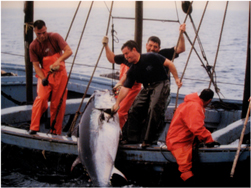 The choices we make as consumers drive the seafood market place. Your purchasing power can make a difference by supporting those fisheries and fish farms that are better for the environment, while at the same time relieving pressure on others that are not doing as well. With nearly 75% of the world's fisheries either fully fished or overfished, these issues are more important than ever. Sustainable seafood is
that which, either fished or farmed, can exist over the long-term without compromising
a species' survival or the health of the surrounding ecosystem is sustainable.
The Monterey Bay Aquarium in California has developed a very useful and informative program called Seafood Watch. The program is designed to help consumers become advocates for environmentally friendly seafood. The following guiding principles illustrate the qualities that capture fisheries must possess to be considered sustainable by the Seafood Watch program. The choices we make as consumers drive the seafood market place. Your purchasing power can make a difference by supporting those fisheries and fish farms that are better for the environment, while at the same time relieving pressure on others that are not doing as well. With nearly 75% of the world's fisheries either fully fished or overfished, these issues are more important than ever. Sustainable seafood is
that which, either fished or farmed, can exist over the long-term without compromising
a species' survival or the health of the surrounding ecosystem is sustainable.
The Monterey Bay Aquarium in California has developed a very useful and informative program called Seafood Watch. The program is designed to help consumers become advocates for environmentally friendly seafood. The following guiding principles illustrate the qualities that capture fisheries must possess to be considered sustainable by the Seafood Watch program.
Species from sustainable capture fisheries:
-
have a low vulnerability to fishing pressure, and hence a low probability of being overfished,
because of their inherent life history characteristics;
-
have stock structure and abundance sufficient to maintain or enhance long-term fishery productivity;
-
are captured using techniques that minimize the catch of unwanted and/or unmarketable species;
-
are captured in ways that maintain natural functional relationships among species in the ecosystem, conserves the diversity and productivity of the surrounding ecosystem, and do not result in irreversible ecosystem state changes;
-
and
have a management regime that implements and enforces all local, national and international
laws and utilizes a precautionary approach to ensure the long-term productivity of the resource and integrity of the
ecosystem.
|