|















 |

About
The Importance of Controlling Our Cholesterol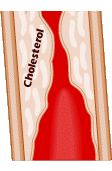
Cardiovascular disease is the leading cause of death among both men and women in the United States. When excess cholesterol and fat are present in the blood, they build up in the vessels causing a narrowing of the arteries. This means that the space through which blood can flow is restricted, leading to high blood pressure. Blood carries oxygen to our heart and brain. Restricted blood flow to the heart can result in a heart attack. Restricted blood flow to the brain can result in a stroke.
This module highlights the five lifestyle practices that can most significantly reduce your risk of heart disease:
Not smoking -
Daily exercise
-
Moderate alcohol consumption (an average daily intake of no more than an ounce of alcohol)
-
A healthy body weight (a body mass index, or BMI, of 25 or less)
-
A healthy diet (with a high ration of polyunsaturated to saturated fat,
low in trans fat, and emphasizing fruits, vegetables, cereal fiber, fish, and lean meats).
Along with portion control, these same guidelines will help one to lose and maintain a healthy weight. Reducing the risk of overweight and obesity will help to reduce the risk of both diabetes and heart disease. Best of all, these same guidelines support optimal health and wholeness.
What Is Cholesterol and How Much Do We Need?
BLOOD CHOLESTEROL
The cholesterol that circulates through our blood is a white, waxy substance.
Serum, or blood, cholesterol travels in particles containing both lipids and proteins.
There are three classes of cholesterol: high-density lipoprotein (HDL),
low-density lipoprotein (LDL), and very-low-density lipoprotein (VLDL).
DIETARY CHOLESTEROL
Cholesterol is present in all animal tissue which is why dietary cholesterol comes from animal foods - meat,
fish, poultry, eggs, and dairy products.
DO WE NEED CHOLESTEROL?
Cholesterol has received a bad reputation due to its association with coronary artery disease.
It is, however, essential to life! It is a component of cell membranes, serves as a precursor
for vitamin D and steroid hormones, including estrogen, testosterone, and aldosterone, and provides insulation around nerves.
With regard to dietary cholesterol, there is no requirement.
That’s because our bodies make all that we need.
For this reason, it is not necessary to consume any cholesterol in order
for our bodies to carry out their functions.
Because dietary cholesterol if found in foods that come from an animal, many of us consume too much of it.
Therefore, current guidelines suggest limiting dietary cholesterol to less than 300 milligrams per day.
GET YOUR BLOOD CHOLESTEROL CHECKED!
Starting at age 20, it is recommended that you have a fasting lipid panel.
There are three components to this lipoprotein profile: Total Cholesterol, LDL and HDL Cholesterol, and Triglycerides.
There are many of you who already take these blood tests routinely.
And there are many of you who have never had this test.
Please do it! We should all have some idea, at least, about our blood cholesterol levels.
Don’t assume that because your are not overweight, that your levels are healthy.
They may or may not be. Keep this in mind: we can burn calories, but we don’t burn cholesterol.
It literally sticks with us – right inside our arteries. So, even if you are thin and athletic,
if you consume excess amounts of fat and cholesterol, you could be at risk for heart disease.
For more information on cholesterol testing, go to
http://www.americanheart.org.
|
Total Cholesterol |
|
Desirable |
Less than 200 mg/dL (5.2 mmol/L) |
|
Borderline |
200-239 mg/dL (5.2-6.19 mmol/L) |
|
High |
240 mg/dL (6.2 mmol/L) or higher |
|
LDL Cholesterol |
|
Optimal |
Less than 100 mg/dL (2.58 mmol/L) |
|
Desirable |
100-129 mg/dL (2.58-3.34 mmol/L) |
|
Borderline-High |
130-159 mg/dL (3.37-4.11 mmol/L) |
|
High |
160 mg/dL (4.14 mmol/L) or higher |
|
HDL Cholesterol |
|
High |
60 mg/dL (1.55 mmol/L) or higher |
|
Low for men |
Less than 40 mg/dL (1.03 mmol/L) |
|
Low for women |
Less than 50 mg/dL (1.29 mmol/L)
|
|
Triglycerides |
| Desirable |
Less than 150 mg/dL (1.69 mmol/L) |
| Borderline-High |
150-199 mg/dL (1.69-2.25 mmol/L) |
| High |
200-499 mg/dL (2.26-5.63 mmol/L) |
| Very High
|
500 mg/dL (5.64 mmol/L) or higher |
This chart shows the relationship between various levels of blood lipids and the risk of developing coronary artery disease (CAD) or a related event such as a heart attack.
High levels of total cholesterol, LDL (“bad”) cholesterol, and triglycerides significantly increase the risk of CAD. Desirable levels are associated with a low risk. A high level of HDL (“good”) cholesterol is considered to be protective against CAD, while a low level is considered to increase risk.
These guidelines are based on the current guidelines from the National Cholesterol Education Program (NCEP) and apply primarily to people who do not have coronary artery disease and do not have multiple risk factors for CAD (e.g. smoking, high Body Mass Index). For these people, the recommended levels are lower.
|