Product Information Labels and Safety Data Sheets (SDS)
Since antimicrobial pesticides are designed to control or kill germs on environmental surfaces they must, to some degree, be dangerous to humans. To determine just how dangerous the given product is, you need to look at two important sources of valuable information before getting started. The product label and the SDS convey the necessary information on how to correctly and safely mix and apply just about any product. It also details what safety precautions need to be taken, and if protective clothing (such as gloves and goggles) needs to be worn. To obtain more information about a product used in your workplace, call the phone number(s) listed on the label or SDS.
Container Labels
All containers of hazardous chemicals and substances must have a label and be marked with the identity of the material, appropriate hazard warnings, and the name and address of the manufacturer. Labels need to have clear, accurate information about the safe use and storage of chemicals in the workplace, and should be highly visible and presented in an easily readable manner. Labels are not required on portable containers into which hazardous substances are transferred from labeled containers, and which are intended only for the immediate use of the employee who performs the transfer. If a chemical is transferred into another container, such as a spray bottle, and it will not be used immediately, then it must be labeled with the appropriate information. Be sure to thoroughly read the label before using any unfamiliar or new chemicals and follow all of the instructions.
Signal Words
Signal words must be present on the label of all hazardous substance containers. These words indicate to the user the level of hazard or toxicity of that substance. The level of toxicity indicates how dangerous it is to humans. For some lower level categories, no signal word is used. The following are signal words you might find on the next container label you read.
 WARNING – In this context, "warning" refers to lesser chemical hazards. The chemical is harmful and must be handled properly, but it's unlikely to cause severe or extreme damage to anything or anyone. All chemicals with a “warning” label posted on them must also be followed by a hazard statement that describes the potential hazards of the chemical in greater detail.
 -
 DANGER – While “warning” is used to describe moderate hazards, “danger” refers to the most serious chemical hazards. If it’s mishandled or used inappropriately, the chemical may cause severe harm or damage to someone's health.
 Just like the “warning” label, the “danger” label must be accompanied by a hazard statement that discloses all of the hazards associated with the chemical.
Hazard Statements
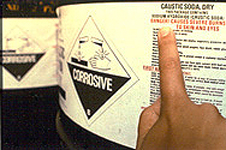
Hazard statements provide standardized wording to indicate the nature and degree of the hazard for a particular chemical, product, or substance. Under GHS: this is a statement assigned to a hazard class and category that describes the nature of the hazard(s) of a chemical, including where appropriate, the degree of hazard.
-
FATAL IF SWALLOWED
-
HARMFUL IF SWALLOWED
-
CAUSES SEVERE SKIN BURNS
-
EXTREMELY FLAMMABLE LIQUID AND VAPOR
-
COMBUSTIBLE LIQUID
-
MAY BE CORROSIVE TO METAL
Precautionary Statements
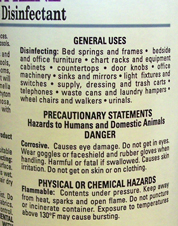
A precautionary statement is a phrase (and/or pictogram) which describes recommended measures that should be taken to minimize or prevent adverse effects resulting from exposures to a hazardous product, or improper storage or handling of a hazardous product. They are categorized according to general, prevention, response, storage, and disposal precautionary statements. They include statements such as:
-
Keep out of reach of children
-
Keep away from heat/sparks/open flames/hot surfaces – no smoking
-
If exposed or if you feel unwell
-
Store in well-ventilated place
-
Dispose of contents in accordance with State and Federal regulations
First Aid Statements
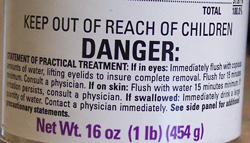
First aid statements are generally found on the labels of the more toxic chemicals and substances and only occasionally for those less toxic. These statements provide information to the user concerning appropriate first aid for the various routes of exposure associated with accidental exposure.
-
If inhaled, move to fresh air
-
Get medical attention immediately if exposed
-
In case of contact, flush eyes immediately for 15 minutes
In Case of Fire or Spill Statements
These instructions are provided to assist in a fire situation or in the clean-up of a chemical release, and are meant to be simple and brief. Suitable spill control materials should be specified. In some cases, it is preferred to let the material burn rather than attempt to extinguish it, and these situations should also be specified. Examples of this type of statement are:
-
Do not flush into sewer
-
In case of fire, use water, dry chemical or CO2
-
In case of fire, smother with dry sand or dry powder agents
Safety Data Sheets (SDS)
Under Hazcom 2012/GHS, MSDS became safety data sheet or SDS and must be in the mandatory 16 section format developed by American National Standards Institute (ANSI). When it comes to working safely with and learning more about the chemicals in your workplace, the SDS (and label) should contain most of the information you need. The Hazcom standard requires an SDS be readily available for all hazardous chemicals used in the workplace. If the chemical is not hazardous, you do not need to maintain an SDS for that chemical. An SDS can be available in the form of a paper copy or an electronic file. Copies of SDS’s for chemicals no longer used or stored at the workplace should be kept for 30 years and stored separately from the current sheets for organizational purposes.
Manufacturers and distributers have converted over to the new format as of 2015. Each SDS has similar look and the information you often look for will be in the same general place. While the format for the new SDS’s are new the same, information contained in each will vary depending on the chemical.