|









 |

Strategies
Are You Really Hungry?
There are strategies you can use to manage supersized
portions. First, and foremost, clue in to your own hunger signals. The
sensation of hunger is instinctual. But, oftentimes, we turn to food for
reasons other than true hunger. For example, do you eat whenever you’re
anxious? Is food one of the few things that makes you feel better? If
so, you may have been conditioned to turn to food for comfort. Do you
eat when you’re bored? This common behavior can easily become a habit.
If you eat as a way to deal with your emotions, consider keeping a food
record of what, when, and why you eat. Recognizing what triggers your
eating can often make it easier to make changes.
Here are some alternatives that can shift our mind-set away from food as a way of dealing with our emotions:
-
Take a walk
-
Walk the dog
-
Call a friend
-
Listen to music
-
Search the web
-
Draw
-
Paint
-
Knit
-
Play the piano
-
Dance
-
Write a note to a friend
-
Take a bubble bath
-
Read an inspirational book
-
Drink some herbal tea, or sparkling water with a hint of juice
-
Write a letter
-
Fold laundry
-
Clean out a cluttered cabinet
-
Water the plants
It’s also a good practice to get in tune with our body’s hunger signals.
Feeling a little hungry at the start of a meal is good, but knowing when you could wait
longer is also important. Eating every time you feel hungry can result in overeating.
If you struggle with this, ask yourself these questions before your next meal.
-
Am I hungry? (If you’re not sure, wait 20 minutes and ask again.)
-
When was the last time I ate? (If it’s less than three hours, it may not be real hunger.)
-
Could a small snack tide me over until the next meal?
(Try and have ready-to-eat fruit or vegetables on hand.)
If you can’t recognize when you’re hungry, make a schedule – eat small meals every three to four hours until you learn what hunger feels like. If you overeat at a meal, get back on track at the next one.
Don’t Supersize at the Salad Bar
Salads can be healthful meals, but depending on which toppings you pile on,
they can turn into a helping of unwanted calories and fat. Cheese, croutons, bacon bits,
nuts and full-fat dressings add up. In fact, an average salad bar plate can top out at
more than 1,000 calories, depending on your choices and portions.
At the Salad Bar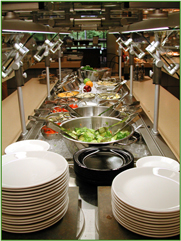
Pace yourself. -
Check out the choices from end to end before you begin making your salad.
-
Use a salad plate, not a dinner plate.
-
Make greens your base, and the darker green the
better: spinach and romaine supply a lot of nutrients.
-
Add plenty of bright colored fruits and vegetables.
These add nutrients, fiber and phytonutrients.
-
Lean meats like turkey, crab, tuna as well as low-fat cheese add protein.
Choose low-fat or fat-free dressing and get it in a cup on the side. Dip each forkful of salad lightly into the dressing.
Or, pass on dressing entirely and have a splash of vinegar or lemon juice.
A salad can be a healthful meal all by itself, or be a great side dish. Just watch your portions and your choices.
Slowing Down in Our Fast Food Nation
There’s no doubt about it. We want things fast. With all of our technological advances, it seems we’ve got more to do than ever despite the fact that there are still only 24 hours in a day. Unfortunately, our societal relationship with food is highly symbolic of our culture’s need for speed: Microwave meals in 5 minutes or less! Lose 10 pounds in a week! If you don’t get your food within three minutes, your next meal is free! Eating on the run, in your car, and grabbing food from a bag are common eating habits for many Americans.
Eating too fast leads to:
Eating slowly is better for your health because it discourages overeating and fosters relaxation, which aids digestion. We can learn from countries like Italy, France, Spain, Greece, and Japan. A meal in these countries often lasts several hours. In fact, one of Greece's dietary guidelines is to "eat slowly, preferably at regular times of the day, and in a pleasant environment." Sharing a meal is so important that Greeks call someone a friend "by saying we have shared bread together.”
Eating slowly and consciously helps us better manage our calories, even when served a supersized portion. Tuning in to the full experience of eating helps us to enjoy our food more consciously which helps us to eat more slowly which gives the body time to signal that it is beginning to be satisfied. Eating on the run deprives you of the very things that make eating enjoyable and healthy. Slow down and savor the experience of eating!
Feeding Our Five Senses
Our technological society has numbed our senses. Why is it that when we go to the movies we have to have something to munch on? Besides nostalgia, eating feeds the senses that the movie does not. The movie only feeds our senses of sight and sound (we see and hear the movie). By getting that bucket of popcorn, we now have something to touch, taste, and smell. That’s why television viewing and obesity are so closely correlated, as well as the fact that the couch potato lifestyle does little to move our bodies. At the office, we sit in front of our computers all day which also does little to feed our senses - aside from seeing words pop up on the screen, the feeling of our fingertips on the keyboard, and the mouse clicking in our ears. By taking time to eat our food slowly and consciously, we more fully satisfy each of our physical senses which helps to prevent overeating.
Next time you eat an apple, try the following eating meditation:

-
Look at the apple. What color is it? Is it dirty or shiny?
-
Touch the apple. How does it feel? Firm? Cold, perhaps?
-
Smell the apple. How does it smell? Sweet? Tart?
-
Listen as your bite into the apple. How does it sound? Crisp? Crunchy?
-
Taste the apple. How does it taste? Sweet? Juicy? Tart?
|