
Chemical Safety
To properly maintain school facilities, custodians may have to use some cleaning products which contain hazardous chemicals. The improper use of these chemicals can cause burns to the eyes and skin and the inhalation of toxic fumes.

Hazard Communication and the Globally Harmonized System (GHS)
GHS development began in 1992 with the idea of standardizing hazard communication by requiring a consistent format for material safety data sheets (MSDS) and the use of standardized label elements including pictograms to depict hazards. Under GHS, MSDS’s are now know safety data sheets or SDS’s. Hazcom 2012, as it is nicknamed, was published in the Federal Register in March 2012 and aligns U.S. hazard communication requirements with GHS. Much of the Hazcom standard remains relatively unchanged. OSHA believes that adopting Hazcom 2012 and GHS will prevent many accidents and injuries as well as save lives.
The Hazard Communication Standard (HCS) is now aligned with the Globally Harmonized System of Classification and Labeling of Chemicals (GHS). This update to the Hazard Communication Standard (HCS) provides a common and coherent approach to classifying chemicals and communicating hazard information on labels and safety data sheets.
Key Changes to HAZCOM
Hazard classification: Provides specific criteria for classification of health and physical hazards, as well as classification of mixtures.
-
Labels: Chemical manufacturers and importers will be required to provide a label that includes a signal word, pictogram, and hazard statement for each hazard class and category. Precautionary statements must also be provided.
Safety Data Sheets: Will now have a specified 16-section format.
-
Information and training: Employers are required to train workers on the new label elements and safety data sheets format to facilitate recognition and understanding.
Using Chemicals
To safely use products which contain harmful chemicals, you must:
-
Read the container label and safety data sheet (SDS) before using a chemical product.
-
Be familiar with all instructions and precautions in using the product.
Use the correct protective clothing and equipment.
Never mix a chemical with another substance, even water, unless so instructed by the manufacturer's written directions for use.
Ask your supervisor if you are unsure about the safe use of a particular product.
Handling and Storage of Custodial Chemicals
Read the product labels and the Safety Data Sheet SDS on the recommended handling and storage of the chemicals you are authorized to use. If you are unsure how to safely handle or store a chemical, ask your supervisor.
When handling and storing custodial chemicals, follow these safety guidelines: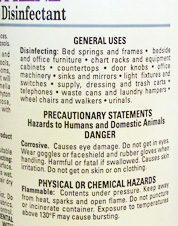
-
Store most chemicals at a controlled temperature and with adequate storage and shelf space.
-
To avoid spills, store chemicals on shelves that are no higher than chest level.
-
Be sure chemical containers are labeled properly and are capped to avoid spills and fume emissions.
-
Rotate products according to their expiration dates, using older products first and safely disposing of any expired materials.
-
If you must store a leftover chemical solution, be sure that the solution is covered and stored in a safe and secure area.
-
Place any stored, leftover chemical solution in an appropriate secondary container with a label indicating the contents.
Use leftover chemical solutions within 24 hours of mixing.
When you mix chemicals, always use a funnel and measuring cup or follow the manufacturer's instructions.
-
After each use, rinse out any chemical residue left on the funnel and measuring cup.
-
Because chemical containers are often heavy, ask your supervisor for training in proper lifting and safe transport techniques.
Safety Data Sheets (SDS)
When it comes to working safely with and learning more about the chemicals in your workplace, the SDS (and label) should contain most of the information you need. The Hazcom standard requires an SDS be readily available for all hazardous chemicals used in the workplace. If the chemical is not hazardous, you do not need to maintain an SDS for that chemical. An SDS can be available in the form of a paper copy or an electronic file. Copies of SDS’s for chemicals no longer used or stored at the workplace should be kept for 30 years and stored separately from the current sheets for organizational purposes.
Below are the 16 sections (in order) found in SDS’s with some of the specific information you might find. Most of the information the user of the chemical needs will be found in sections 1 – 11. Sections 12 – 16 contain information that is more often needed by those involved in shipping the chemical, spill cleanups, or hazardous waste activities.
Section 1
Identification
-
Product identifier used on the label
Other means of identification
-
Recommended use of the chemical and restrictions on use
Name, address, and telephone number of the manufacturer, importer, or other responsible party
Emergency phone number
Section 2
Hazard(s) Identification
Classification of the chemical
Signal word, hazard statement(s), symbol(s), and precautionary statement(s)
Description of any hazards not otherwise classified
Section 3
Composition/Information on Ingredients
Chemical name and concentration
Common name and synonym
CAS number and other unique identifiers
Section 4
First-Aid Measures
Description of necessary measures subdivided according to the different routes of exposure
Most important symptoms/effects, both acute and delayed
Indication of immediate medical attention and special treatment needed, if any
Section 5
Fire Fighting Measures
Suitable (and unsuitable) extinguishing media
Specific hazards arising from the chemical (combustion products)
Section 6
Accidental Release Measures
Personal precautions, protective equipment, and emergency procedures
-
Methods and materials for containment and cleaning up
Section 7
Handling and Storage
Precautions for safe handling
Section 8
Exposure Controls/Personal Protection
-
OSHA PEL and ACGHI TLV
-
Engineering controls
-
Administrative controls
PPE recommendations
Section 9
Physical and Chemical Properties
Appearance
Physical state
Odor
pH
Boiling point
Specific gravity
Solubility
Section 10
Stability and Reactivity
Stability
-
Reactivity
-
Incompatible materials
-
Conditions to avoid
Section 11
Toxicological Information
Information on the likely routes of exposure
Symptoms
Delayed and immediate effects
Numerical measures of toxicity
Section 12
Ecological Information
Ecotoxicity
Persistence and degradability
Bioaccumulative potential
Mobility in soil
Section 13
Disposal Considerations
-
Description of waste residues and information on their safe handling and method of disposal
Section 14
Transport Information
-
Transport hazard class
-
UN proper shipping name
-
Packing group
-
UN number
-
Environmental hazards
Section 15
Regulatory Information
Safety, health, and environmental regulations specific for the product in question
Section 16
Other Information including date of preparation or last revision
-
The date of preparation of the SDS or the last change to it