



General Safety
There are many activities in the theater environment you might be asked to perform that require prior adequate training. Once trained, some of these activities can only take place under the supervision of a designated faculty or staff member. Never perform any activity that you have not received proper training on and if you do not feel confident or safe about an assignment, talk to your supervisor about it.
Activities that require training include:
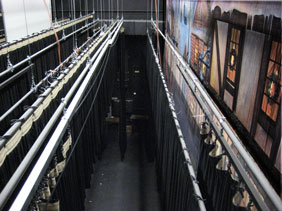
Using ladders, lifts, and chain hoists;
Using power tools, pneumatic tools, or dangerous hand tools;
Installing, connecting, running or testing lighting or sound equipment;
Conducting electrical repair work;
Rigging or pre-rigging scenery;
Shifting or moving scenery;
Using flammable or toxic chemicals;
Running special effects; and
Working on catwalks, the grid, or at heights.
Basic Stage Safety
Props should be safely secured.
Costume racks must be stored away from entrances, exits, and stairwells and never block aisles or pathways.
Edges of floors, trap doors, and orchestra pits should be clearly marked with electro-luminescent materials or embedded light strips.
Trap doors should close properly and be inspected frequently.
Never leave open traps unattended without using barricades to warn others if you must leave the area.
Grooves and raised edges in the floor must be clearly marked.
Elevations should be clearly marked.
Floors should be sturdy, solid, and not sag.
Floors should be clean, dry, and free of slippery materials.
Pathways should be clear of all obstructions.
Rotating or moving stage sections should be adequately marked.
Inspect the stage for holes, bowed or warped sections, water damage, loose areas, soft spots, raised screws, nails, or staples, splintering, and raised edges.
Know the load limits of the stage and trap doors before using heavy equipment or objects on them.
Fall protection using nets or other means should be installed by professional services.
Never work directly under any type of overhead activity and warn others of the danger.
Chemicals
 Solvents, paints, and other chemicals are frequently used in the shop and stage areas. Many chemicals produce toxic fumes and gasses and will readily ignite by way of flame or heat. The key to safely using chemicals is to read the label and become familiar with the health hazards, physical hazards, safe handling procedures, and first aid procedures before opening the container. Do not use any chemical, which has no label affixed to the container. Never mix chemicals as this may result in an unpredictable and dangerous reaction. Used chemicals require proper disposal and most cannot be thrown in the regular trash.
Read the product label or MSDS for this information.
Chemicals should only be used in a well-ventilated area.
Keep chemicals away from heat sources such as water heaters, space heaters, welding activities, smoking, and electrical panels and equipment.
All chemicals shall be stored in approved containers.
All containers must be clearly and accurately labeled.
Wear the proper PPE for the chemical being used.
When not in use, containers of flammable substances shall be stored in an approved flammable storage cabinet.
Be sure to read the Material Safety Data Sheet (MSDS) when using any new or unfamiliar chemicals.
Rags, brushes, and rollers used to apply oil-based materials should be disposed of in airtight containers and never in regular trashcans.
All hazardous materials used in the theater must have an MSDS on file.
Use water-based chemicals and paints whenever possible.
Use caution with spray cans, as most contain extremely flammable propellant and other hazardous materials.
For spilled materials, consult the MSDS for cleanup procedures and notify your supervisor.
Keep a lookout for unauthorized chemicals brought into the theater by staff, students, or volunteers.
Provide oversight and education on chemical safety to those students who will be using chemicals.
Housekeeping
Accident prevention begins with housekeeping and should be practiced by everyone involved in theater productions. A clean and organized work area is required at all times.
Keep items put away as they can become tripping hazards as well as fire hazards.
Clean up the work area frequently to avoid clutter.
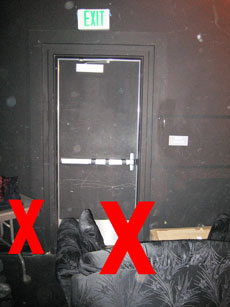
Keep all aisles, walkways, and exits clear of materials, equipment, and other items.
Clean up spills and other slippery debris immediately.
Remove trash and non-essential items from walking and working surfaces.
Remove trash and waste materials from the building on a daily basis or as needed.
Can you identify the hazards present from this lack of houskeeping?
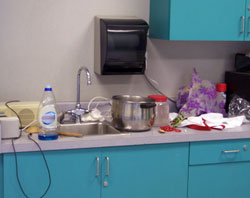
Electric shock and fire hazard
Can you identify the hazards present from this lack of houskeeping?
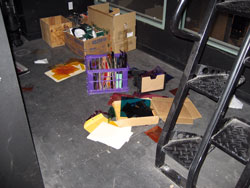
Slip, trip, and fall hazard
Can you identify the hazards present from this lack of houskeeping?
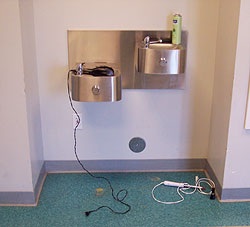
Slip, trip, and, fall hazard
Can you identify the hazards present from this lack of houskeeping?
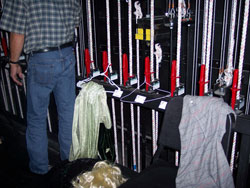
Trip and fall; compromised rigging
Can you identify the hazards present from this lack of houskeeping?
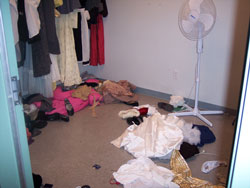
Slip, trip and fall hazard
Can you identify the hazards present from this lack of houskeeping?
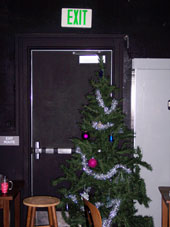
Fire hazard and blocked emergency exit
Please continue below.
Personal Protective Equipment (PPE)
-
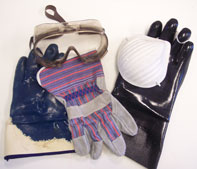 Always wear proper work clothes and shoes. Open toe shoes and sandals should never be worn unless part of the actual production.
 -
Wear leather gloves when handling rough objects such as wood or metal.
-
Proper eye protection should be worn when operating tools, equipment, and machinery or when working with overhead objects. If there is a chance something might get into your eyes, wear eye protection.
-
Hard hats must be worn while working underneath overhead activities.
-
Hearing protection should be worn during activities such as using power tools, working next to sound systems and special effects, which may generate excessive levels of noise.
-
If a particular machine or process requires the use of specific PPE, be sure to obey the rules.
-
Respirators may be required at certain times. Be sure you are properly trained, fit tested, and medically qualified before using an air-purifying respirator.
-
Activities such as welding require specialized knowledge and PPE. Only trained and qualified individuals shall operate welding equipment.
-
Fall protection must be worn when required by OSHA regulations.
Lifting, Back Safety, and Material Handling
Many workplace injuries are the result of improperly lifting heavy or awkward objects. Much of the equipment and material found in theaters and used in theatrical productions fall into this category.
-
Get help from other people when moving or lifting heavy, large, or awkward objects.
-
Use material handling equipment like dollies, hand trucks, carts, or lifts when possible.
-
Be sure to keep your back straight, bend your knees, lift with your leg muscles, and keep the load close to your body.
-
Check your path of travel before lifting an object and moving it to another area.
-
Remember not to twist your back while moving the load.
Hand and Power Tools
-
Students should not be allowed to use any equipment unless they have been trained and are supervised when necessary.
-
Permission forms need to be kept on file for students that are allowed to operate certain power tools.
-
Never work alone with power tools such as saws.
-
Make sure the tool is in good working condition and never remove guards.
-
All power tools need to be properly grounded.
-
Unplug when not in use.
-
Use the right tool for the job.
-
Keep your hands away from moving parts and wear the appropriate PPE.
Miscellaneous Safety
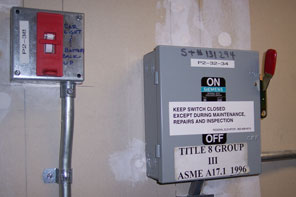 Safety signs should be appropriately used to convey important messages about a safety hazard or an important rule to follow. Too many signs and people will not bother reading or even take notice of their content. Make sure signs are not blocked or covered.
Eyewash stations should be present in areas where there is a reasonable chance of particulates or harmful liquids contacting a person’s eyes and must not be blocked.
-
Hardhats are recommended to be worn anytime work with rigging or other overhead activities may subject those below to falling objects.
If any equipment appears to be unsafe for any reason, do not use it and take efforts to ensure that no one else does either.
-
Specialized equipment should not be altered, repaired, or replaced without the proper authorization.
-
Visitors should not be allowed on stage or have access to hazardous areas in the theater.
-
Platforms of all sizes and shapes constructed onsite should be sturdy, never overloaded, and inspected before use.
-
Look for worn or raised edges of carpeting that may be a tripping hazard.
-
Volunteers that assist in the productions in any way should be properly trained, depending on their role.
-
Be aware of all overhead electrical wires and cables and avoid contacting them with metallic objects as it may create a shock hazard.
-
Cables that must be run across walkways must be covered and signs posted to warn of the hazard.
-
Avoid using materials such as rigid plastic foams, flexible foams, cardboard, and any other material that burns easily and emits significant amounts of toxic vapors when heated.
Question?
Continue to Next Chapter